
Summing Up Sicily
A Sicilian author, the universal blindness of the publishing industry, and other observations
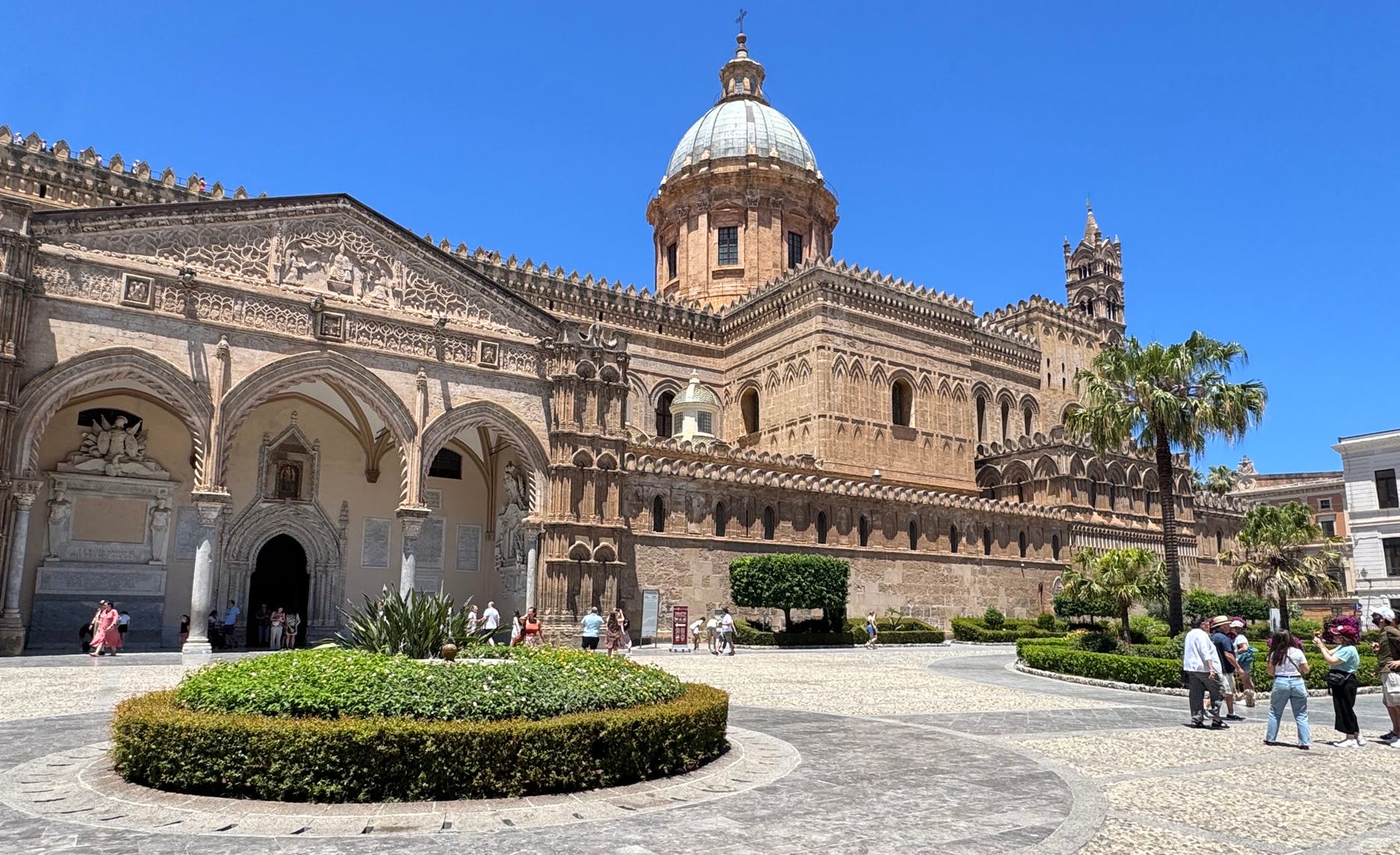
We’re back home after another week in Sicily — Palermo this time — and it’s time to sum up the experience, put things in perspective, and maybe offer a few suggestions to those of you who may visit the island in the future.
On the trip back to the states I watched the movie Fuori, which means “out” or “outside” in Italian. It’s based on the real life experiences of the Italian writer Goliarda Sapienza, whose novel The Art of Joy was rejected by the Italian publishing industry in her lifetime because of its scandalous nature. It portrays an early twentieth-century Sicilian woman who seeks freedom from conventional morality, sleeps with both men and women, commits incest, and murders a nun. The book took nine years to write and drove Sapienza to impoverishment.
In the movie, a desperate Sapienza, ridiculed by a friend, steals some of the woman’s jewelry, eventually gets caught, and spends time in the Rebibbia women’s prison, where she bonds with several other women in the unique culture of the institution. Those bonds lead her to write about that life, resulting in a book, L’Università di Rebibbia, which was published to minor success.
Later, she marries, and after her death her husband, Angelo Pellegrino, continues to champion her work. He finances the publishing of 1000 copies of The Art of Joy1. The book is eventually noticed, and then published in France, where it sells over 300,000 copies. It’s finally published in Italy in 2008, and is now recognized as a classic. Sapienza was posthumously named one of the greatest Italian writers of the twentieth century. Just like in the U.S. the Italian publishing industry seems unable to recognize good literature.
Allora…
I’m not the biggest fan of architecture. I’m more of a lifestyle person. As I mentioned to my wife, all I need is good food, good wine, and good conversation. One of the nicest things about Sicily was the ease with which we were able to get to know our fellow tourists. There were the Brazilian couple and the woman from New Zealand with whom we learned to cook Sicilian; the Parisian woman dining alone with whom we wound up talking with for nearly an hour; the German foursome who liked what we were eating at a streetside café and followed our lead when ordering; and the British couple we met at the winery who gave us Palermo bus passes they couldn’t use.
The food was great everywhere we went. Take any kind of tour and the locals will ply you with street food — all deep fried btw. There’s chickpea fritters and roasted prosciutto-wrapped spring onions and the ubiquitous arancina (in Palermo) / arancino (in Catania), which are rice balls surrounding savory fillings, breaded and fried. And plenty of seafood, of course. You can get it fried, but it’s better as part of a pasta or risotto dish, which you can find at the higher end places.
Yes, my wife and I are a little snobbish about that. As I mentioned before, the Michelin Guide lists a couple dozen Sicilian restaurants and we visited five of them during our stay. Badalamenti and Bye Bye Blues are in the Mondello area of Palermo, and both are fabulous. But who would have thought Catania was a foodie town? If you go there definitely visit Materia | Spazio Cucina and Ménage, two of the most creative restaurants we’re ever visited.
But if it’s architecture you want Sicily has its share. Most of the island, whether east or west or center, is a combination of centuries-old stone buildings and early-to-mid twentieth century housing stock. If you’re looking for the spectacular you should try the Cattedrale di Palermo and the Norman Palace. They’re within walking distance of each other. Afterwards, have lunch at A’ Putía nearby, an authentic deli and grocery that makes a memorable focaccia sandwich.
My wife says I have a knack for finding the authentic amid the schlock. A bit of it has to do with how hard someone is trying to sell you something. The less pushy, the less likely the product is junk. In Noto we wandered into a small fabric shop that had place settings and towels and table runners we hadn’t seen before. As soon as I saw the old woman at the sewing machine (who reminded me a lot of my grandmother) I knew she was the craftsperson. Yes, she said, she made everything in the place. You just get a feeling sometimes.
Sicily, in general, is a poor place. It’s never been an economic powerhouse. Much of its history was spent as a colony of greater powers. Even as part of Italy it’s often looked down on by residents of other areas. There’s a lot of obvious poverty here. It’s not uncommon to be approached by wandering accordion players, street peddlers, or to have a child under ten stand at your outdoor table with a plastic cup asking for spare change.
People seem to do whatever they can to get by. There are a couple of major street markets in both Catania and Palermo, and outside those are often streets filled with vendors selling whatever they can, which often looks like items discarded by established stores, or even goods rummaged from the trash. It makes for a strange combination of desperation and hustle.
Italy does have a social safety net, but it is not as robust as the systems in place in many other European countries. Residents have minimum income support and universal healthcare. Some may be eligible for rent assistance and food support. But the economy in Sicily is weak compared to the rest of Europe and even much of the Italian mainland, and it shows.
We were also surprised by the lack of accessibility here. To get up or down in these old buildings you take the stairs. There are no escalators or elevators and more often than not there are no handrails. The stairs aren’t always level either. Many streets have no sidewalks, or one’s so narrow pedestrians are forced to walk in the streets (which, if you have experienced Italian traffic, you know is a life-threatening proposition). Obviously much of the architecture was constructed long before modern accessibility standards. But I can’t help wondering what it is like to be old and frail in a place like that.
Personally, as a bit of a history buff, when confronted by such differences to modern or American standards, I try to wrap my mind around the thinking that guided the construction when it was built. There are stairs, but why would anyone need a handrail? Why a sidewalk? If people need those things they become a burden. And anyway it’s up to the family to take care of the old and sick. Some research shows that many elderly Sicilians live with adult children, especially in non-urban areas, which allows them to remain integrated into the social life of the community. And despite the lack of infrastructure and regulation to serve the disabled and the elderly, the average lifespan of a Sicilian is still greater than that of an American. Must be the good food and wine I mentioned. Maybe the conversation too.
I’ll get back to writing about writing on Saturday.
Photo of Cattedrale di Palermo by Dona.
I just ordered my copy.
My paternal grandfather, born and bred in Stromboli, attended classes in their one-room schoolhouse for a few years only. But he taught himself to read, write, and carve beautiful things from wood. He made splendid wine from grapes he grew himself. And I learned so much about Italian Grand Opera as a tot from my Eolian grandparents. "Poverty" - - in my eyes - - defines people who grew up with a TV instead of with a keen appreciation of real culture.
Sapienza's story reminds me of John Kennedy Toole here in the US. Roundly rejected in life but then awarded a Pulitzer a decade after his death. So much comes down to who's reading your work and whether they connect with your voice.