
Sicily Day 4: The Server Difference
To tip or not to tip
Those of you who have traveled in Europe know that restaurant servers typically don’t expect tips for their work.
For those of us who frequent restaurants in the states, it takes a while to get used to the difference. When we first started visiting overseas, Dona and I automatically calculated the usual 20%, and if we paid cash we’d just add that extra to the payment. Yeah, we’d heard that waitstaff here don’t expect tips, and we’d read the advice that said if you’re going to leave a tip, keep it to 10% or less, but good old American, we’re-the-richest-country-in-the-world-and-we-got-that-way-by-taking-advantage-of-everyone-else guilt kicked in, and we’d leave the 20-plus extra.
Now we mostly pay by card. Usually there’s no line on the bill where you can add a tip, and no breakdown of what a 15%, 20%, or 25% gratuity would be to encourage diners to think that a tip is mandatory.
A couple of nights ago we wanted to offer something extra to our server, who had suggested a dessert item that wasn’t even on the menu (an incredible house-made pistachio ice cream). Again there was no tip line on the bill, and I mentioned that to her. Could we offer a cash tip? Oh no, no, she said. Maybe leave a good review about the restaurant.
After all these years of overseas travel, I finally started to try to pay closer attention and figure out the differences in philosophy1.
Seasoned travelers know that dining out in most of Europe is part of a lifestyle that looks at it as more of a right than a reward for financial success. You’ll never be rushed through your meal to make room for the next guests. You’ll typically have to flag your waiter down to get the check. You can stay as long as you like. You won’t be asked, mid-bite, how the meal tastes. You won’t be referred to as, “you guys.”
The drawbacks are that at less expensive places you may never encounter your waiter again unless you make the effort. No one will refill your water or ask if you’d like anything else. Even at the high end establishments the waitstaff is friendly and attentive, but still a bit formal. They don’t typically ask your names or offer theirs. They don’t try to engage you in conversation. It reminds me a little of the discussions we’ve had on this Substack about the differences between commerce and art. At the nicer places we’ve been to here, the decision is to focus on the art of fine dining.
In Europe, waitstaff is, in general, fairly compensated in comparison to their American counterparts. Some research shows that national labor laws or collective bargaining agreements often establish minimum compensation that is much higher than in the U.S. Benefits such as paid vacation, sick leave, healthcare, pension contributions, and stronger dismissal protections are more common. Waitstaff may not have the opportunity to achieve the same high incomes that experienced servers at luxury establishments in the U.S. do, but then they never have to face working in places that pay far below minimum wage because waiters are “assumed” to be making enough tips to cover the difference2 — and that means diners aren’t made to feel guilty for the shortcomings of restaurant business ownership.
It seems restaurant work is one of the more secure and gainful pursuits over here. One of our local guides mentioned that in Sicily, the general economy is so weak that many young people live with their parents well into their 30s. Research shows that seems to be true for much of Italy, especially the southern regions. But the practice is also more culturally acceptable here.
The cultural and political values that frame the differences in restaurant practices are important too. In the high-competition, capitalist United States, individual ambition and effort have long been valued over baseline protections, although that changes sometimes, depending on the political mood of the country. In Europe, generally speaking, it seems like those protections have become the priority and are entrenched in policy. And restaurant workers have benefited because of that. Some Americans consider that socialism; others call it progress.
Either way, having had some opportunity to understand the practices here more fully, I’m now okay with not tipping…mostly. I still stop for a second when paying a restaurant bill, and have to remind myself that’s just the way it’s done.
What do you think about these differences? I’m especially interested in your overseas dining experiences, as well as what you think about tipping practices both there and in the U.S.
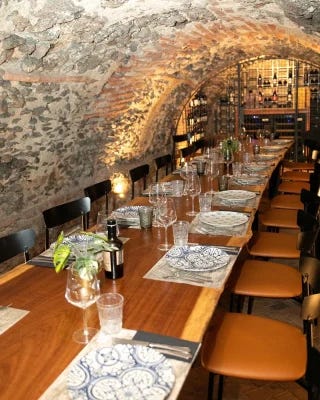
Photo: The large dining room at Acqualavica in Catania.
Yeah, yeah, I probably should have done this much sooner, but one doesn’t usually go on vacation to indulge in philosophy.
Federal law allows employers to pay as little as $2.13/hour in direct wages if tips bring workers up to minimum wage, one of the most abusive and shameful practices in the American economy, imho.
Hello Joe. A thoughtful reflection that shows how something as simple as tipping can reveal deep cultural differences. Enjoy Sicily—it’s a wonderful place. As always, thank you so much for sharing.
In Southern Italy, these small establishments are family-run and there is a pride taken in doing a good job, serving a wonderful meal, and in customer satisfaction. Even the early morning baristo -- who has truck drivers for customers -- will pride himself on remembering how Giovanni likes his coffee, how Carlo prefers "caffe corretto," etc. In contrast, here in NYC, invariably the waitstaff has aspirations to break into acting and waiting tables is just what pays the rent until the waitress / waiter can get an agent.