
Our First Two Days in Catania
Great food, great people, really bad music
Just a reminder: I’m using this space for my traditional travel blog while my wife and I are in Sicily. I’ll be back to writing about the writing biz on June 20.
Sicily, as a true history buff knows, has been one of the most invaded places in the world. The island lies in the middle of the Mediterranean Sea, and has seen a procession of conquerors, including the ancient Greeks, Romans, Vandals, Ostrogoths, Byzantines, Arabs, Normans, Germans (Swabians), French, and Spanish before the island became part of unified Italy in 1860 — and it took an invasion led by Giuseppe Garibaldi to make that happen. That didn’t mean the invasions stopped, either. Sicily was the stepping stone for the Allied invasion of Europe in World War II.
So what does it mean to be a Sicilian, then? My father’s family came from Corleone, in the southwest of the island. Yes, that Corleone, birthplace of what the Italian friends of my youth and I called the Mothers And Fathers Italian Association. Popular culture considers the Mafia a violent crime organization, and that’s true. Before the turn of the 21st century the Mafia was as powerful here as the Italian government. People either joined, condoned, or lived in fear of them. It took a major effort — almost a war — by the government in the early 2000s to bring them to heel. But the Mafia’s origins also had a lot to do with the search for identity and autonomy. It ain’t easy knowing your country and your people have been history’s doormat for thousands of years.
And yet the Sicilians Dona and I have encountered just in our two days in Catania are fiercely proud of their city and identity — that’s human nature I guess. They talk about how the people of the Italian mainland, and even Palermo in the west, still look down on them, and how they return the sentiment by maintaining differences in everything from how to pronounce certain foods (it’s arancino here, not arancina), and the movement to preserve Sicilian as a language instead of a dialect. I asked Luca, the guide on our street food tour, whether most residents spoke Sicilian or Italian. Sicilian is an oral language, he said, so it’s not taught in school. It’s up to families to keep it going.
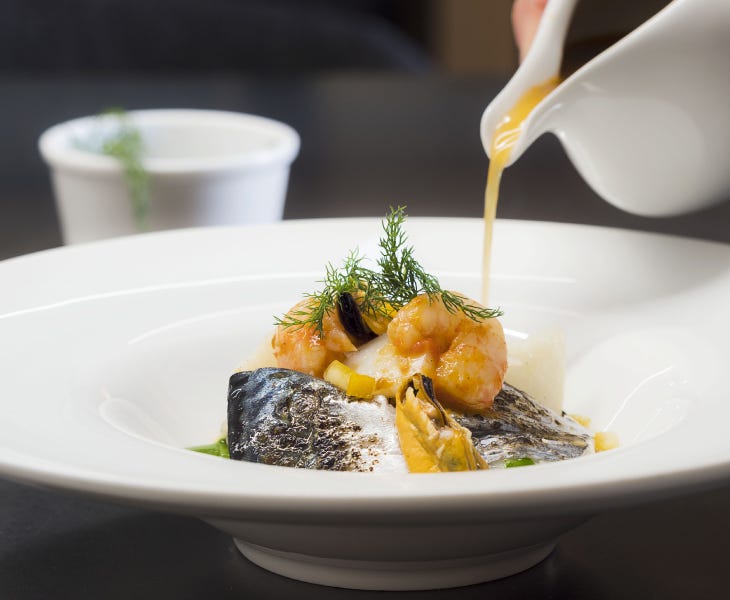
Catania is an old city. It’s a mix of ancient structures and rather run-down looking buildings dating from maybe the 1960s and ’70s. We’ve haven’t seen any new construction yet. But the facades aren’t what Sicilians care about anyway. Instead it’s the quality of the moment, as in enjoying a great meal and excellent wine. Two days here and we’ve experienced two restaurants that wowed us. Acqualavica (conveniently located next to our hotel) and Materia Spazio Cucina are both Michelin star establishments1, but you sure wouldn’t know it looking at them from the outside. Acqualavica’s seafood risotto was spectacular. Materia, under the guidance of Chef Bianca Celano, is well known for its inventiveness, and it did not disappoint. Think BBQ lettuce with mustard sauce, crunchy bread, and aged goat cheese — and that was just our appetizer.
The excellence of Sicilian cuisine, however, is countered by a strange obsession with what I can only call really bad music. I’ve noticed this throughout our travels in Italy. Popular music here, piped loudly into too many public places, is simply awful. It’s a combination of bombastic, disco-like pop tunes, ’80s American pop, and Italian cover versions of those tired one-time hits. One particularly obnoxious a song sounded like Barry White crooning through a bout of indigestion. We’ll just have to learn to tune it out.
Tonight Dona and I try our hands at pasta making. Let’s see if we can get into the spirit of fine cuisine. More later.
Photo: Courtesy of Materia Spazio Cucina
A little travel tip: Michelin has in the past few years altered their philosophy what constitutes a fine dining establishment to include more accessible and affordable places, without sacrificing quality. You can find superb restaurants in almost any city now by visiting their website.
"Pasta making"....? I was given the job of hand-making pasta and ravioli for our family suppers when I was four years old. After rolling out the dough, I trimmed each strand with a metal pizza-wheel. Made the night before, dozens of pasta strands were "cured" overnight in our basement, hung up on bakery string. Ravioli was stuffed with ricotta, etc. and refrigerated overnight. The good old days ... when Italian families bottled their own "sauce." . . . . . I've written about our pummarola ritual, too.
Thanks. Great fun to read.