
Have Publishing Professionals Become Mediocre Bureaucrats?
The pressures of the biz may give them no choice
Quick note: Starting today my wife and I will be traveling in Sicily for a couple of weeks. We will be on an airplane as you read this, so I won’t be able to respond to comments for a while. And I won’t be posting anything about the writing world during those two weeks, but will instead be using this space for my travel blog. I don’t write the usual travel stuff — it’s more about history and culture. I hope you’ll find it interesting. If not, I’ll be back to writing about writing on June 20.
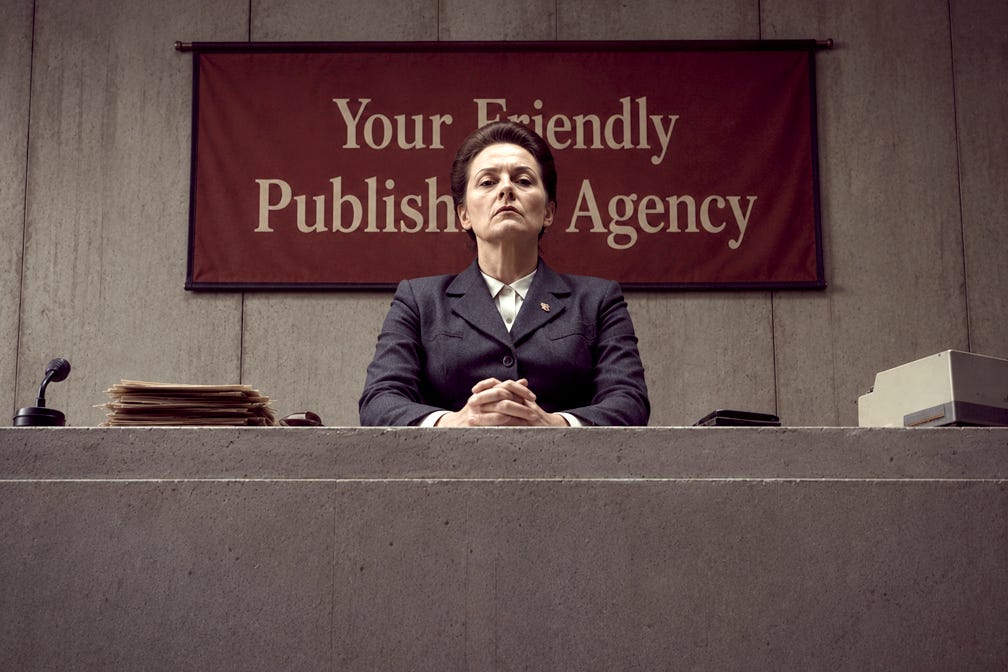
Recently I read an essay titled Actually, Democracy Dies in H.R. by Amanda Taub in The New York Times. The subtitle was, “New research sheds light on how mediocre employees help would-be authoritarians maintain power.”
The article claimed that such leaders stayed in power in part by cultivating incompetent bureaucrats and (sometimes violent) security forces who are motivated not by ideology, as you might expect, but by job security and personal interest. People like that, who can’t get ahead in other fields, do well in authoritarian governments because all they have to do is follow the rules that other, more talented or moralistic people refuse to comply with. They are the yes men. Or the yes men with guns.
On the same day I read a post by Substacker Michael Mohr, who offered, “Bring Back Literary Blood, Guts and Cum,” regarding the what he sees as the complete lack of imagination and true humanity in current fiction. I’ve seen plenty of other posts that say pretty much the same thing.
Michael O. Church, who linked to the Taub essay, suggested that the mediocrity phenomenon extends to other organizations, and that the effect can subsume even talented, credentialed employees, turning them into bystanders as the mediocre employees enforce the authoritarian will.
Being the imaginative, iconoclastic interdisciplinarian that I am, my mind synthesized all this into a theory that may explain the state of fiction at larger publishing houses.
Is it possible that the people who make decisions about what gets published fit the description of workers that Taub suggested in her essay? Are literary agents, acquisition editors, cover designers, and other publishing employees not the foresight-gifted illuminati of the literary world, but more like the mediocre employees that maintain the status quo?
And have writers, pressured by the demands of the industry, allowed the same thing to happen to them, churning out unchallenging books that pander to the industry’s current tastes? Substitute “the publishing system” for “authoritarian leader” and it seems to work.
Mohr offered comments from well-known writers who said that good fiction has traditionally challenged power. He quoted from Philip Roth’s The Ghost Writer: “…literary history was in part the history of novelists infuriating fellow countrymen, family, and friends.”
Where are the novels that can infuriate today? Where are the ones that challenge current orthodoxies?1
There are nonfiction titles that do this. But the novel has always had a special place in literature as a more subtle means of getting people to look at issues from the perspectives of individual characters, which allows readers to experience the impacts of those issues from the emotional inside, as well as the factual outside. It has always been a powerful influence on people’s opinions because it creates a more personal experience.
Publishing industry professionals are generally people who have advanced degrees in some aspect of literature, and who have a lifelong passion for books. By nature they have always been independent and intelligent.
But something changed in the last couple of decades in higher education, especially in the east coast schools that feed the publishing industry. Major media have reported on how some people, ranging from political figures to education experts, believe that curricula at these universities, especially in the humanities, promote not intellectual development, but political indoctrination. I have provided a sample list at the end of this essay.2
And something changed in the last couple of decades in the publishing industry. All of the big five publishers were acquired by larger businesses and therefore made to focus more acutely on profit. These companies now take fewer risks on new writers, relying on those who speak to already popularly held views on culture.
Additionally, the sheer number of people who want to be published by the big five has made those who work in the industry less responsive to the writing community. Michael O. Church has also written about literary agents ignoring query letters, as well as other practices that hurt writers.
The result, imho, is that despite their innate intelligence and independence, the people who work for the major publishers have become the equivalent of Taub’s mediocre employees. They are inundated with queries, face long odds when approaching publishers, and (especially for newer agents) often have financial woes, forcing them to take other gigs like teaching and freelance editing that further detract from the time they can spend agenting.
This is exactly the kind of stress that bureaucratic employees experience — too much work, too much managerial and political pressure to do anything more than maintain the status quo, and little to no opportunity to challenge current orthodoxy.
I doubt that the people involved in publishing think of themselves this way, or that they unintentionally became the mediocre employees who can cause an entire industry to stagnate or even to become an adversary of the people it purports to serve. But in the big picture that doesn’t matter. They are too much on the inside to notice what has happened to them and their industry.
I think this is what happens in virtually every large industry and government. People want to feel secure, that their future is secure, and what better way to do that than to advance through whatever organization you happen to be a part of by playing according to established rules. The organization, or system, is devoted to its own self-preservation and profit. If the organization is large enough, your position in it is too insignificant (and probably too stressful) for you to effect real change. To speak out against industry orthodoxy is to court banishment.
Not that any of this is an excuse for the bad practices Church alleges. If he is accurate in his reporting, then many literary agents are misrepresenting themselves to writers — in a business supposedly based on trust. It sounds a lot like the treatment you might receive from a bureaucrat in an authoritarian government.
Can it change?
As long as industry leaders, a.k.a. publishers, remain at least somewhat profitable there is no compelling reason for this to change. Change would have to come from market forces influencing the decisions of those leaders. Publishers would need to start losing money, which would encourage them to make changes to their products. I don’t see that happening anytime soon, because the reading public generally seems happy to be coddled and not challenged by novels. As Mohr put it, “Today everyone seems to be ‘in experience’ with their own egos and little groups and political ideology and their iPhones and social media.” If he’s right that’s not the kind of cultural attitude that fosters challenging literature.
Does my theory hold up to your scrutiny?
I asked ChatGPT to suggest some recent iconoclastic novels, but the results were disappointing. The books it suggested were critical of associated aspects of social politics (such as methods) while maintaining strong ties to liberal orthodoxy in the publishing industry. Overall the books reinforced current liberal doctrine rather than challenging it. That being said, please don’t get the idea that I’m some kind of right wing conspiracy guy. My politics are liberal, but not extreme. I’m just reporting on how I see the industry.
A few links to articles in major media regarding U.S. university curricula:
The Atlantic – “The Coddling of the American Mind”
The New Yorker – “The Unmaking of the American University”
The Wall Street Journal – “American-Studies Journal Articles Biased Against U.S., Analysis Says”
The Wall Street Journal – “Evidence Backs Trump on Higher Ed’s Bias”
Good morning Joe. Another thoughtful essay; many thanks. I have not been writing/publishing very long (less than 4 years), but I have found that often what I send to journals (and previously, to agents) has been ignored, sending a generic "unfortunately" response automatically after a number of weeks. A large part of what I write is auto-fiction, and a large number of editors are young and have not experienced "life", so how could they respond otherwise? Also, many have graduated from MFA programs that teach formulas, not creative writing. Is it any wonder that much of what is published today is boring, unchallenging, and banal?
Enjoy Sicily.
Eric (E.P. Lande)
In the 1980s' - 90s' published short stories in glossies were read by millions, and the competition for publishing was fierce, but editors searched for and recognized stories that told a story that readers wanted to read. Today, editors no longer care about what readers want because there are no longer any readers in any kind of numbers. Now, editors seem to only care about the style of syntax that matches their own biases. I used to get $2,500 a story from Redbook ($8,000 in today's dollars). How does the zero-pay-today model compete? It doesn't, and writing sucks. My guess is that the good writing that remains is not getting submitted; the best writing today is probably only found in letters exchanged between lovers, where the only editors are the hearts involved.... syntax and spelling and style be damned.